
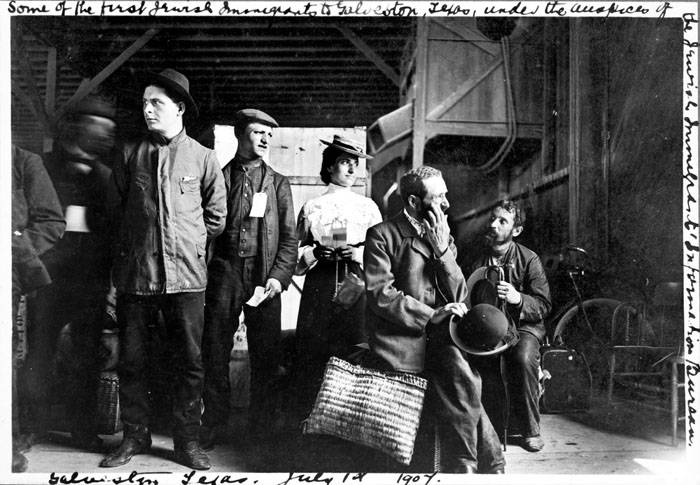

Between 1880 and 1924, some four million Ashkenazi Jews came through Ellis Island, and their descendants make up about 75% of American Jews today. In this conversation hosted by the American Jewish Historical Society, Dr. Joel Dinerstein of Tulane University talks about growing up in Flatbush, Brooklyn, the son of two immigrants who arrived in 1923 as children. He describes a Jewish life built on diaspora, family, and neighborhood rather than on the Holocaust or Israel, and how that upbringing led to his scholarship on race, jazz, and American cool. His new memoir, The Last of the Ellis Island Jews, is a portrait of a working-class family, a hilarious and complicated mother, and a world that is rarely documented. The program closes with a note from Austin viewer Jeff Cohen, whose father, Dr. Joseph Cohen, founded Tulane's Jewish Studies Program in the early 1980s.
Video courtesy of the American Jewish Historical Society, which hosted and produced this program.
About Dr. Joel Dinerstein
Dr. Joel Dinerstein is Professor of English at Tulane University and holds the Sizeler Family Professorship in Judaic Studies. He earned his Ph.D. in American Studies at the University of Texas at Austin. His work looks at how anti-Semitism and anti-Black racism connect through culture and resistance, and he is a leading expert on the idea of “cool.” He curated the 2014 exhibit American Cool at the Smithsonian's National Portrait Gallery and is the author of Swinging the Machine, The Origins of Cool in Postwar America, and Jazz: A Quick Immersion. He is also founding editor of the Lost Classics of Jewish Literature series at UNO Press. His memoir, The Last of the Ellis Island Jews, was published in 2026.
Read the full transcript
Lightly cleaned up from an auto-generated YouTube transcript — filler words trimmed and names corrected, wording otherwise unchanged. Timestamps link to that moment in the video.
[0:00]Host: It's always wonderful to be here, and we have another great guest, Joel Dinerstein, who will be speaking to us today from New Orleans, where he is a professor of English and Judaic studies at Tulane University. Joel is an internationally recognized expert in the meaning of cool. That's what I said, cool. Specifically the American cool that originated with African-American jazz musicians as a matter of style but also resilience. He has studied the relationship between anti-Semitism and anti-Black racism, often through the lens of African-American literature, popular culture, and Jewish American literature. Today he will talk about the path that led him to this field of expertise in a most personal way in his evocative memoir, The Last of the Ellis Island Jews. Here it is. And Rebecca is going to post in the chat where you can buy a copy for yourselves. Like all good memoirs, this one is about family but also about the world they inhabited. With pleasure, I welcome Joel Dinerstein to Out to Lunch.
[1:20]Dr. Dinerstein: Hi, [host's name]. Thank you for that welcome. I'm happy to be here with you today.
[1:29]Host: Good to see you. So you've written this book at a fraught time in Jewish American identity. And maybe it's always been fraught one way or the other.
Dr. Dinerstein: Yeah.
Host: But I think it would be great if you could start by explaining what you mean when you say Ellis Island Jews, both culturally and historically, and then we'll talk about what it meant to you personally.
[1:57]Dr. Dinerstein: Yeah, sure. It's certainly one of the reasons I wrote the book, into this moment of fraught Jewish identity. In a literal sense, the Ellis Island Jews are the immigrants who came over through Ellis Island, the 4 million European Ashkenazi Jews between 1880 and 1924. They constitute 75% of all American Jews. To some extent, in the last 40 years, most of Jewish identity has been focused on either the Holocaust or Israel. I did not grow up with that. I grew up with more of what we call a diasporic identity. So when I heard younger Jewish people speaking of their education being entirely focused on the Holocaust, I thought that was not a rich way to have Jewish identity when you could have this long history, the diaspora, the sacred texts, the ethics, the resilience, the community, all of that.
But in terms of the Ellis Island Jews, I wanted to bring American Jewish life, the experience of the 20th century, back to the table and back to discourse. And I happen to have a very singular perspective on this. That immigration ended in 1924 with the Johnson-Reed Act, and my parents both came in in 1923 as 9- and 10-year-olds. They both were from shtetls. They were native Yiddish speakers. They were religious in the old-country sense. And of course I was born very late in their lives, when they were in their mid-40s. So you can't be much younger than me biologically and have a first-generation experience of the Ellis Island migration. And since my parents remained working class my whole life, they weren't successful, we didn't move to the suburbs. We stayed in Brooklyn.
I also knew all of my relatives on both sides, like third cousins, to like four generations of American life. My grandfathers were born in the 1880s. So to some extent I have a very singular perspective that I wanted to bring to the table. And of course I also wanted to write a kind of tribute to my Jewish mother, who, even though in a very bad, abusive marriage of 54 years, managed to raise four children to be successful people in the world. She was also quite a character, both hilarious and complex, a little cartoonish sometimes. I always sort of knew I'd write about her in some form, and this is the form it took.
So I'm writing it now to say I think we need to recuperate diaspora within an American Jewish identity, which is sort of gaining some traction among rabbis and scholars and various people. And I wrote it to say this is what it looked like to grow up with a diasporic identity before the Holocaust, and Israel, became the center of identity.
[5:14]Host: I was thinking about it because I'm pretty sure you mentioned it in the book, but for people tuning in today and later when they tune in afterwards, who's the literary compatriot to this? Who are the famous writers of American Jewish literature that come from this? They might not be your age, because we'll talk about your weird family configuration later, which covers three generations within the family. But what are the literary sources, do you think, that parallel your personal experience?
[5:55]Dr. Dinerstein: Right. So I actually teach the Jewish American literature class at Tulane. In fact, I'm teaching it right now. It starts really with Abraham Cahan's novel The Rise of David Levinsky. Cahan was of course the founding editor of the Forward. In a sense The Rise of David Levinsky is like a sociological presentation for America of the Jewish immigration. It may not be a great novel, but it's a very useful novel, so I tend to start with that. I read Anzia Yezierska's book, Bread Givers. That's the sort of story of immigration. There's also the incredible memoir The Promised Land by Mary Antin, which is very little known at this point, but it is an incredibly vibrant narrative of that movement of the immigrants. Her vivid recollection of Russia, and then her saying I literally came to another world and was another person in Boston, is really great.
In terms of the people I grew up reading, in terms of diaspora as an identity, there are the big guys, Saul Bellow and Philip Roth and Bernard Malamud. There's Grace Paley, who I love and read when I was fairly young. There's Cynthia Ozick, sort of after that, not after, during and still. After I read those kinds of novels in the class, some Malamud stories, Portnoy's Complaint, which I still read because it's still hilarious. And then I read some of the Holocaust writing, because American writers didn't really start writing about the Holocaust overtly until the '80s. So Cynthia Ozick's The Shawl, and then Art Spiegelman's Maus.
And then another great and very little-known novel, and I don't quite understand why, is Marge Piercy's novel He, She and It. I think people don't know it in part because it's a little sci-fi and it's set in the future, and because Marge Piercy is not usually associated with overt Jewish writing. But it's a great novel, and I'll talk about it for like one minute because it's very important at the moment, because there's an AI component.
Basically it takes place in 2049. She wrote it in 1992 and the world is in the control of multinational corporations and there are really no nations anymore. And the Jewish people have preserved their independence because they sell the best cyber security on the planet, which is also incredibly prescient given Israel and its cyber security industry. The two main early characters are an estranged couple who were both robotics scientists. They keep trying to create an android who will protect the province of Tikva, which is also a great name for where the Jews live. It's sort of a combination of New England and Newfoundland. They want an android strong enough, what we would call now a kind of AI-engineered robot, to protect Tikva.
But here's the real kicker. All their androids either blow themselves up or don't have enough sense to have an identity. And so what Malkah, the female Jewish scientist, does is she reads him the story of the Golem every night before he goes to sleep. So there's this two-tier narrative of the future and all of its problems, climate change, everything, and then the Golem as a predecessor for any AI we might create. That two-tier narrative works beautifully. And she also makes a major character out of Chava, who is the Maharal's daughter, who was in fact known to be quite learned. So it becomes Chava and the Golem story. Anyway, I went on for quite a while. But I love this novel. My students love the novel. It's called He, She and It.
[10:38]Host: Oh yeah, and Rebecca, could you put that in the chat, He, She and It? And maybe a link to a bookstore or Amazon where people can buy it, or the library, obviously. It sounds fabulous.
Well, listen. This is so interesting, because one of the things I've been thinking a lot about is the whole Ellis Island Jews idea. Full disclosure, I had a particularly weird background. My parents were Holocaust survivors, but they settled in a small town in Appalachian Ohio where there were no Jews. So all New York Jews were alien to me, except for the ones I read about in books. All those books you're talking about were my introduction to what I thought of as real American Jews. But the Ellis Island thing is also interesting because we know from The Godfather, we know from A Tree Grows in Brooklyn or whatever, there were a lot of other Ellis Island people. I think your book is very much about that. I'd love for you to talk about your Flatbush Jewish upbringing, which is, it is what the book's about really, what that mix of people was like and what that meant and how that ultimately led to your work dealing with Black culture. If you could just set the stage a little bit for what the Flatbush of your childhood was like.
[12:15]Dr. Dinerstein: Sure. I grew up in one of the most Jewish neighborhoods in New York and in America. Barbra Streisand went to my high school. Neil Diamond went to my high school. Bernard Malamud went to my high school earlier. Erasmus Hall High School, which is a fabled high school, and in fact was the second-oldest public high school in America. I mean, it still is. But it was still a very diverse neighborhood in terms of Irish and Italians, and then later African Americans, a little later in my childhood. To some extent it was a very Jewish neighborhood in as much as the people that I knew and hung out with, although not entirely. I talk about the cultural comfort of Flatbush Jewishness. There was no sense in which we were outsiders at all.
It was also during a time, and I know you interviewed him recently, David Denby, and his book on eminent Jews, I grew up in the period of his four Jewish stars, Mel Brooks and Betty Friedan and Norman Mailer and Leonard Bernstein. They were all stars in the firmament, and I grew up in this period. He has this great phrase in the book that it was a time, quote unquote, when America was Zion enough. That is a great phrase and it's really how we felt. We felt very much like Americans, and how you felt about Israel was very much off stage. I mean, it was there but it wasn't central at all. We were American Jews.
Early in the book I get mad at Ben Stiller for playing a kind of nebbishy Jewish man so late in the century. This is the '60s and '70s, and I grew up, and all my friends were good athletes, and we weren't nerdy, and we didn't need anyone's approval. That was all Woody Allen movies and needing WASP approval. So I was pretty angry at Meet the Parents. I thought, why is this here anymore? That's just a way of centering how we felt about our lives. It's not about anti-Semitism or feeling like an outsider. It was quite the opposite. We felt like insiders, and of course New York is the most Jewish city on the planet. So that was there too.
But I grew up still differently from all my friends, which is to say my parents were immigrants and they were never modern Americans. They never really became modern. Their mindsets were really very much the old country and the shtetl in certain ways. They felt very American, but they were clearly not so much. I have an older brother and sister who are 12 and 15 years older than me. So to some extent we had, as you mentioned, three generations in the house. And we were close as siblings. I have another sibling who's a year older than I was, who I have always been very close to. So there we are in Flatbush. Most of my friends are also more or less working-class Jewish people. It is very much a comfortable, stable, middle-class neighborhood. One of the reasons I wrote the book was I wanted to show what affordable, vibrant neighborhood life was once like. We talk a lot about affordability. We didn't make much money. Here's how that looked. I know we can't go back to that. I know all the problems involved. But I did want to show that vision.
So in general we have Flatbush Jewishness. We have a kosher home, which I write about. I went to Hebrew school for 5 years. I thought the Jewish past was amazingly compelling whether or not I felt religious. One of the things I wanted to do with the book, besides showing what this kind of diverse Jewish life looked like and how that led to my work on race and racism and cool, which I'll get to in one second, is that in the memoir there's a scene for almost every major Jewish ritual. There's a bar mitzvah scene, there's a bris scene, there's a seder scene, there's a trip to Dachau. I have a staring contest with the Rebbe, Menachem Mendel Schneerson, and each one of them has a comic twist. So I had to walk a tightrope between telling Jewish readers things they knew about and giving a new perspective on things they're familiar with, while also showing non-Jewish readers what our rituals looked like and what they meant.
[17:20]Host: So before you go to your work on Black culture, I have two things. I just don't want to leave this train of thought for a minute.
Dr. Dinerstein: Good.
Host: First, we have a message from somebody in Southern California thanking you for articulating essential truths about Ellis Island Jews. "Mine arrived just in time in 1924." But before you go ahead, do you talk about this with your students now? How do they respond to it? What's their reaction? I mean, that would take too many sessions probably, but how do you see their attitude toward their Jewishness compared to yours, say?
[18:06]Dr. Dinerstein: This is an excellent question. Many of them, most of them, are secular and ethnic, not all but most. So I always have to judge the amount my class knows about anything Jewish, including the Torah or the Talmud or any of Yiddishkeit or any of it. That means I have to teach the class in a way that presents it as new material and yet keep it fresh, so that is difficult. Their attitude changes. Right now it's very odd, because the students in this class, and it may just be group dynamics or this year, are definitely very invested and engaged in their Jewish identity, which is ethnic and not religious. And most of the ones in my class are very much, even if they don't say so, pro-Israel and not pro-Palestine. I don't know whether that's about Tulane or just whether it's about the people who are taking my Jewish American literature class.
The way I get the diasporic part across is that the readings do all the work. To teach Bernard Malamud and then teach Portnoy's Complaint, and Portnoy's Complaint is an entire presentation and parody of growing up diasporic and kosher and not with immigrant parents but with parents who really have that background. So the readings do the work, and then I provide the personal testimony. The first time I taught it, about 15 years ago, I thought that my personal testimony, literally my being a living relic of this, would be helpful for my students. And I think it has been, to be honest. So that's how I do it.
[20:11]Host: Interesting. So many questions about your family, but I would like to talk about your upbringing and how that led you to the work you've done. So much of your scholarship over the years has really been about African-American culture and issues of race. If you could tell us, which you talk about a lot in the book, how you made that journey.
[20:46]Dr. Dinerstein: I'm mostly known for my scholarship on race and Black culture and cool and American music, most of which is Black music, at least in its foundation. Starting in high school, I spent all my money from my night job on used records, so I was always into music. But the thing about race, I went to predominantly Black public schools, like 80% Black junior high school and high school, and to some extent all my work comes out of that experience. I was sensitive to issues of race almost immediately, in ways that I can't even necessarily explain, the way that a writer has a subject or feels drawn to a certain situation. Some of the stories I tell in the book, my best friend from junior high was present and does not remember them, and he is very progressive on these issues. There are ways in which I was drawn to literally thinking, what is race, what is racism, how did this begin. Those were questions I was asking in a very raw way when I was in high school, when I was 14 and 15.
Very quickly, one of the stories I tell in the book to get started is that I'm in the schoolyard at Walt Whitman when I'm in ninth grade, and we always played football in the schoolyard. Everybody played, whites, Blacks, Chinese, Latinos, everybody played. Right before the bell rang, this group of white kids were walking around just talking to white kids. I thought, what's this about? When they came over to us, and I'll tell a shortened version of the story, they said, if you could press a button and it would eliminate all the Black people in the world, would you press it? This is 1971 in Brooklyn. This is not Alabama or anything. They expected you to answer yes, and I was 13. My first thought literally in my head was, that's not even a question you get to ask. It was a very Talmudic response, right? I eventually said no and I got shoved into the fence, and luckily then the bell rang. We went back to class. My best friend Dave was next to me and does not remember this, and I of course had never forgotten.
There were also all kinds of things about race that I was fascinated by. In 11th grade we had a new student, and he walked in wearing an expensive gray overcoat and black-rimmed glasses, and when he spoke out loud I was kind of stunned. He had a British Oxbridge accent. I didn't even know how that could have happened based on my Brooklyn upbringing. But Brooklyn was and still is one of the places in which there are large populations of Jamaicans and Trinidadians and Caribbean Blacks. He had gone to a boarding school in England. His mother was Jamaican. She married a man, they lived in England, then they divorced, and she moved back to Brooklyn. Here he was at Erasmus. He was very British. He was standoffish, and we were friends but at a distance. Here I was fascinated by Black music and culture and graffiti and sports, and he wasn't interested in any of that stuff. He was interested in cricket and soccer. These were the first stops along my route of what is race, how is race different from culture, what is Black culture, where does it originate.
I'll only add that since I was a rock and roll kid and we kind of all knew it came from the blues, I then did my first deep personal intellectual inquiry into the blues. There wasn't a lot on it in the early '70s, but there was enough, so I read a lot of that. Everything from there follows from those questions, those experiences, my Black friends in high school, the fact that there was white flight and the neighborhood got rougher and my parents and all my friends moved to different neighborhoods. One of the things I try to do in the book is complicate the white-flight-to-the-suburbs story by saying that none of my friends moved to the suburbs. We were working class. We didn't have money to buy houses. So we moved to Sheepshead Bay or we moved to Rego Park in Queens. But that is another story about Jewish liberalism and the problems that nobody was trying to solve about race and crime and social inequality, economic inequality. All of that was on the table, and there is actually very little honest writing about that period. So I don't solve anything. I just said, well, here is what I was thinking and here's my testimony and witnessing of that period.
[25:52]Host: Yeah, it's so interesting to read and to think about. And I think now it's so complex, right? That's the problem with the way everybody thinks about everything today. Everybody wants to be column A or column B or column C, and they're all mushed together in real life. But I was really taken by something you talked about pretty early in the book, and you've said it here too, that you wanted to explain that American Judaism at one point was not just about Israel and not just about the Holocaust. And yet you write, well, tell us about your visit to Dachau, and how that was both a weird experience on its own but also really informed your work and your thoughts about racism. I think that's really interesting. If you could set the stage of that visit.
[26:57]Dr. Dinerstein: Yeah, sure. I did want to write about what it was like to have a diasporic identity. I'm in Europe, I'm with my friend Jim Stern, and we are in Munich, and we have this interesting experience. We're on a bus going somewhere, maybe a museum, I don't know, and we run into a Jewish couple and they tell us of their visit to Dachau. Both mine and Jim's upbringing was so diasporic that we weren't even aware that Dachau was nearby. We were not thinking, being in Germany, we should go sightseeing in Dachau.
Host: And what year was this about?
Dr. Dinerstein: 1981.
Host: Uh-huh.
Dr. Dinerstein: The Jewish couple judged us harshly and shamed us. So of course we went to Dachau. It was a 20-minute ride, and none of what is now mass tourism existed then. It was a suburban station. There was no signage. We had to ask where it was. We walked through this very suburban neighborhood that looked like Merrick, Long Island, except with different house styles. Then we get to the gate and somebody was selling Jewish kitsch, which kind of offended me. There was just one souvenir place and we went inside. Then what you had to do was watch this 45-minute documentary introduction, which was compelling, and then go and visit the camps. All of it was horrifying, of course. I don't need to repeat that for anybody. But I knew a little but not this. The camps were shocking, the ovens were shocking, where the Zyklon B came in and gassed people was shocking. It was shocking to see the other side of the fence, in which the commandant lived a normal life with flowers and trees, which that movie's about, and The Shawl mentions.
But ultimately what really changed me about race was that when I watched that movie, I learned about the Nuremberg Laws. The notion that you could suddenly just make laws that racialize a people and they become racial others who are no longer citizens had a real impact on me. It was years before I would learn, of course, that those Nuremberg Laws were influenced by the Jim Crow laws in America. That scholarship didn't come out until 10 years ago. But I made the connection intuitively, that that's what we have in the United States, that we have racially other people. Once you do that, you can treat them any way you want, because the dominant population will not feel that they are your citizens and compatriots. That was really the main connection that happened at Dachau. It was less about connecting to my Jewish identity, which of course it did, but it really said, oh, this is how race works. You create this, you legalize it, you reinforce it by tradition and custom and language, and then it just seems like biology. So that was really my experience at Dachau.
[30:22]Host: Yeah. It's been interesting to me over the years that that's definitely become a thematic thread, even in various Holocaust museums, to show the link between the Holocaust and other forms of racism. But now I feel like we're in a new era where everybody is so hunkered down in their corner that that empathy or outreach or whatever it is seems to be less prevalent. You're face to face with students all the time, and I wonder if they see that connection, do you think, in the way that you had that aha moment?
[31:00]Dr. Dinerstein: Yeah, I think they have in the past, but I think you are right to identify that we are in a new place, and it has made my current teaching a little confusing, to be perfectly honest. I'll make this statement. I used to think, until fairly recently, that the biggest problem in America was its racial problem. That's me. That's my work. That's what I thought, right? And now I think that it might be, and it's still a huge problem, but because of where we are politically it's like number seven, behind democracy, the rule of law, climate change, AI, all of those things, right? So I do think my students have a sort of fragile hold on their identities and on their futures. And so psychologically I don't think they can afford for this to be as big an issue for them. That's just my theory at the moment, because I'm making those connections that I've made for years in the classroom and they're not really landing in the same way. They're concerned, but it's not really happening. This is the year in which it's most clear to me.
[32:20]Host: Yeah. Interesting. Well, look, that's a subject we could talk about for a long time, but I do want to go back to the book. I think a great many people fantasize about writing family memoirs, and you had said yourself that in some ways you've been writing this book your entire life.
Dr. Dinerstein: Yeah.
Host: And yet your family dynamic was so interesting. You had two sets of children that were separated by many years, so it was like two pairs of not twins but close to it, separated by many years. They're all very successful, but they also went different routes politically and otherwise. I guess it's the old nature versus nurture, but in the course of writing the book, how did it change your memory even of your childhood?
[33:22]Dr. Dinerstein: First of all, try being a smart kid and growing up with a much older pair of politically invested siblings. One of whom self-identifies as a Marxist-Leninist feminist, was totally a second-wave Upper West Side of New York feminist, and one of whom, from the age of 16, was a free-market Republican conservative and Trumpist, which he still is. So I learned a lot being in the middle of that, to say the least. But they were also opposite people. They were not only opposite politically, they were opposite kinds of people. And then my sister and I were pretty much hippie kids. We went to summer camp, I had hair down to the middle of my back, and we had some of the hippie utopian hopes that came out of the '60s, even though it was the '70s.
I wanted to tell that story too, because most of the baby boomer memoirs and memories are around the '60s, but the two years with the highest birth rates are 1957 and 1958, and that's me and my sister. We mostly grew up in the '70s. So I thought we should have a say and that I would put on paper some resonance for our generation. I knew I would write about my family in part because we have this odd dynamic. We have two sets of kids and an 11-year difference. Through the memoir I knew that the emotional axis of the book was going to be between me and my mother, because we had a fairly special relationship that went through a lot of different phases. And my father is the person I learned the most about writing the book. My father was very abusive to my mother, and a saving grace in my family was he was not abusive to any of his kids. He was, in fact, weirdly childish and nice to us in a kind of emotionally limited way. But the way he treated my mother, and he yelled at her every night, luckily he wasn't physically abusive, was foundational for all of us. So much so that we never discussed it, and we were people who talked. We were a verbally aggressive New York Jewish family, and we never talked about it.
So I wanted to write a tribute to her. My mother was also hilarious, intentionally and unintentionally. She was 4 foot 10 and a half and had a Betty Boop-ish voice. People thought she was so cute, and she was, but she was complex and she had her own psychological issues to work out. I knew I would write because I knew it was a singular family dynamic, and I knew that's what a memoir needs. If you're going to write a family memoir, you need to have a fairly singular dynamic in the family, and that I knew I could provide. I probably started writing my first memoir about my family when I was in high school. I just did what you do as a New York Jewish person. I transmuted my family's trauma into jokes. That was therapeutic. I mean, it helped. But I came back to it now because I just realized about 5 years ago that I wanted to make sure this story got told, that I was teaching Jewish studies anyway, and so all of this was very fresh every time I taught it. And I wanted to write a tribute to my mother. What I learned about my father in a way was that he was just limited and set in a very old Jewish patriarchal way from the old country and just never really opened up his mind or his heart. As I say at the end of the book, he was a coward in a way, and that is what led to him being withdrawn from life and from his family.
[37:30]Host: Interesting. I have to say, I'll have to call you up and ask you this, because I had a lot of questions about your dad. You talked a lot about him being abusive, but a lot of scenes in the book are affectionate to you and your siblings. There were definitely points in reading the book when I thought, I want to sit these two guys down and let them have a conversation. Except he's dead, so that wouldn't be possible.
Dr. Dinerstein: Not possible.
[38:07]Host: Not possible. We're getting close to the end. I can't believe this, but I have a few questions here that I didn't have my Q&A up for, and people want to know. So we're going to do a lightning round. Somebody said, "Great conversation. I'm a volunteer educator, aka tour guide, of the abandoned hospital complex at Ellis Island. Can you share any recollections of your parents at Ellis Island?"
[38:33]Dr. Dinerstein: I don't have much about my parents, although both sets of my grandparents are on the wall at Ellis Island. I only have one anecdote, and I learned it late in life from my mother. My mother's father came over first, and while he was away his wife gave birth to twins, my mother and my aunt Ria. So the first time my mother saw her father was at Ellis Island when she was nine. When they were being processed she asked her mother, will I see my father? At that point her father was in view, and my grandmother apparently said to her, that man, that's your father. She pointed ahead like 20 yards and said that's your father. It's very hard even for me to comprehend what that moment might have been like. But that's the only anecdote I have.
[39:33]Host: But that's a good one.
Dr. Dinerstein: It's a good one.
Host: Well, this is a pretty big question, but let's see. Is the relative decline of racism as an important social problem caused entirely by the rise of other problems, or is some of it because racism, looked at by itself, has somewhat abated?
Dr. Dinerstein: I didn't get the beginning of that.
Host: Is the relative decline of racism as an important social problem caused entirely by the rise of other problems, or is some of it because racism, looked at by itself, has somewhat abated?
[40:10]Dr. Dinerstein: So I don't think there's been any kind of decline in racism. I think the decline of American society in every other way has seemed to dwarf it as a problem. Meaning, if we can't get back to democracy and the rule of law and a functioning government, then we can't do anything about racism. So it's really much more that that I am bemoaning here.
[40:36]Host: Yeah. Right. Now this is a kind of abrupt one, but we're doing a lightning round. Do non-Jews take your class, and if they do, what motivates them?
[40:48]Dr. Dinerstein: This is a strangely fun question. My current class, I think, is nearly all Jewish, but I teach a class called Jews and Race, and it's my only thousand-year class. We start with the Crusades, which is when I suggest that Jews were initially actually racialized. Before that there was religious persecution, but I start with that. One of the best classes I ever taught, and I've only taught that class four times, was half non-Jewish, and the best students were not Jewish. That was a really unusual dynamic. What had happened, because I spoke to some of them, was that I had a couple of history majors who were now learning European history from a completely different perspective, and they loved it. One of my best students said, "This is the only class I've ever done all the reading for in my entire Tulane education."
Host: Wow.
Dr. Dinerstein: That class tends to work because no one has a leg up. There are very few students who would know any of the material I'm teaching in the Crusades, the Inquisition, and the pogroms, and the fact that there was a Polish-Lithuanian Republic. All this is new. But Jewish American literature is a little bit more of a balance. I have had a lot of non-Jewish people in that class.
[42:16]Host: Interesting. This is a really fast one. What summer camp did you go to?
[42:22]Dr. Dinerstein: I went to Camp Wel-Met, which is a very well-known camp from that period. I went for seven years, and there's a short chapter on it. One of the only markers of Jewish ethnic identity that I still share with my students is summer camp. They still go to summer camp, and weirdly they still know some Broadway tunes, more so than the general American youth population.
[42:52]Host: That's great. Joel, this has been fabulous. I'm going to close this out with a comment from somebody who's tuned in, and it says, "Not a question, and I'm enjoying the presentation. My name is Jeff Cohen and I'm in Austin, Texas, and I'm the son of Dr. Joseph Cohen, who founded the Tulane Jewish Studies Program in the early 1980s. He too loved teaching the Jewish American lit classes. Thank you so much," he says. And I do too. This has been really great. And everybody who enjoyed this, which I think is everybody, this is the book. You can see in the chat how to get it. Thank you so much, Joel. This has been terrific.
[43:35]Dr. Dinerstein: Thank you, [host's name]. This has been really fun.