
_-_002.jpg)
December 4, 2007 · Austin American-Statesman
Brenham's B'Nai Abraham Synagogue Down to Two Members as Small-Town Jewish Life Fades
View original source →Full Transcript
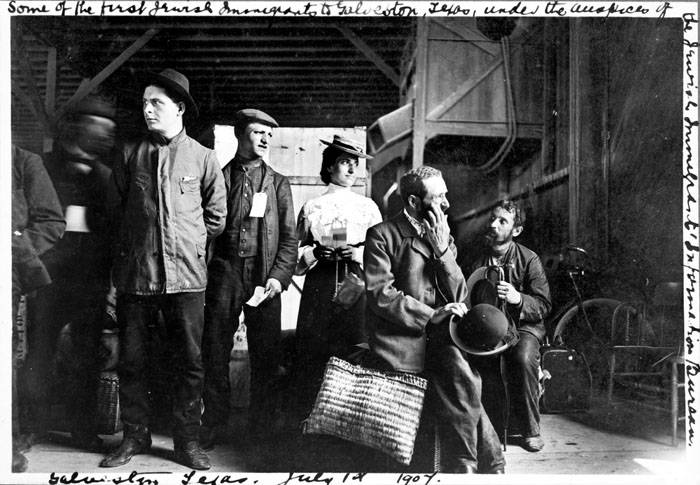
KEEPING THE LIGHTS AGLOW Brenham synagogue's last 2 members maintain a building and its memories By Corrie MacLaggan | AMERICAN-STATESMAN STAFF BRENHAM — The small sanctuary is empty, as usual, but Leon Toubin can still walk through and picture it full of people. "My grandfather used to sit here; Mr. Susnitsky used to sit here," he says, moving among the folding chairs that long ago replaced wooden benches. "Everybody had their place." Five generations of Toubin's family have worshipped at B'Nai Abraham Synagogue, a white clapboard building near the town square. Now, he and his wife, Mimi, are all that's left of one of the state's oldest Orthodox Jewish congregations. There are no regular religious services at the synagogue anymore. No rabbi. No Hebrew school. Built in 1893, B'Nai Abraham was once the hub of the Jewish community in Brenham, a town of 15,000 that's home to Blue Bell Creameries. There were religious services three times a day. This time of year, the congregation's 45 families would light menorahs at home to celebrate Hanukkah, which begins tonight. But nearly all of Brenham's Jews have long since left for places like Houston, Austin and Dallas. See MEMORIES, A6 [Photo caption, A1] Leon Toubin and his wife care for B'Nai Abraham Synagogue and its cemetery. The couple are the last two members of the synagogue, which was built in 1893 and used to have a congregation of 45 families. Though there are no longer services, the Toubins open the building to Jewish groups. (Laura Skelding, American-Statesman) — continued from A1 — MEMORIES: Membership shrank as Jews left for college and never returned Jewish populations have dwindled in many small Texas towns. Synagogues have become churches or schools. Corsicana's Temple Beth-El, for example, is now a community center owned by the city. Meanwhile, places like Georgetown have seen a rebirth of their Jewish communities, said Hollace Ava Weiner, co-editor of "Lone Stars of David: The Jews of Texas." It's not that Jews don't live in small-town Texas anymore, she said. "Jews," she said, "are moving to the same places other people are." They're not moving to Brenham, at least not that Toubin can tell. He and his wife take care of the synagogue and its nearby cemetery, where his parents are buried side by side. They ensure that the roof is maintained, the inside cleaned, the grass clipped, tombstones repaired, sunken graves filled in. "You do whatever you have to do," said Toubin, a Stetson-topped retiree who opens the building to visiting church, temple and civic groups. "This is not my synagogue. I only take care of it." He's 79; his wife is 74. Nobody knows what will happen to the building, a state historic landmark, when they no longer can. He sometimes goes to say afternoon prayers in the synagogue, the same place he had his bar mitzvah as a boy. And he hopes for a miracle: that Jewish people will return to Brenham. Bound by faith Toubin's maternal grandfather, Joe Levin, came with his parents from Poland in the early 1880s, arriving in Brenham by rail via Ellis Island. There he met his wife, Mary, whose family had also come from Poland. Brenham's Jewish community, which predates the Civil War, was bolstered by the arrival of those immigrants from Poland and from Lithuania in the late 19th century. Like other Texas towns with railroad depots, Brenham lured Jewish merchants who set up shops. Some sold shoes and clothing; others had fruit stands. Toubin's great-uncle repaired umbrellas; his grandfather, a traveling peddler, sold shoelaces and pencils and returned to Brenham for the Sabbath. "The synagogue was the glue that bound them together," said Toubin, who ran the family's now-shuttered department stores that his grandfather started. Founded in 1885, B'Nai Abraham, which means Children of Abraham, first met in the Second Texas Infantry Band Hall. Toubin's grandfather was a charter member. The founders built a synagogue in 1892, only to see it destroyed in a fire the next year. They quickly replaced it with the current building, from which the outside looks like a rural church or schoolhouse. Inside, the wood-paneled sanctuary with arched windows has the look of a synagogue in an Eastern European shtetl, or village, with a platform in the center of the room where the Torah and other texts are read. The synagogue, Weiner said, is "a pristine example of Judaism in the old country directly transplanted to Central Texas." As the Jewish community grew, Brenham had a rabbi and a kosher butcher, a Hebrew school and a ritual bath. But by World War II, the community had begun shrinking. After 1943, when the last rabbi died, a visiting rabbi would come for holidays. By the 1950s, it became difficult to gather a minyan, the quorum of 10 Jewish men over age 13 required to hold services. One year, Toubin's mother, Rosa, used radio announcements to invite Jewish soldiers to Brenham for the High Holy Days. They came from Fort Hood and elsewhere to attend services for Rosh Hashanah, the Jewish New Year, receiving free room and board from community members. Ten days later, on Yom Kippur, Day of Atonement, the soldiers worshipped in the morning but didn't want to return for afternoon services: The World Series was on the radio. Toubin was dispatched to fetch them. "They came," he said, "under duress." By the late 1960s, Toubin's parents started making regular treks to Houston for religious services. Brenham's young Jews went off to college and never returned. The older folks passed away, including Rosa Toubin, who cared for the synagogue until her death in 1989. That's when her son took over, maintaining a building full of memories. Hoping for rebirth Toubin fears that he will be the last caretaker for B'Nai Abraham's synagogue. His three grown children live in Houston and Dallas. "It's a little treasure," Toubin said. The synagogue, he said, is owned by the B'Nai Abraham Synagogue and Cemetery Association, but the membership of that group is not defined. As a Recorded Texas Historic Landmark, B'Nai Abraham gets some protection. Anyone wanting to remodel the building must notify the Texas Historical Commission, which can issue recommendations but can't keep the building from being demolished. "In the end, the only thing we could really do is take away that designation" as a historic landmark, said Bratten Thomason, director of history programs at the commission. Toubin's greatest hope is "that there will be a rebirth of Judaism in Washington County, that a Jewish population will resurface again, and the synagogue can be used for worship and a center for the growth of Judaism." This, he admitted, is unlikely. With no regular Sabbath services and no religious school for children, it's hard to attract Jewish families. "Which comes first," he asked, "the Hebrew school or the people?" His backup wish is for a synagogue in Houston or elsewhere to take over B'Nai Abraham and maintain the building and the cemetery, making it "a bright, shining beacon for future generations." When Jewish grade-schoolers from Houston come to visit, he tells them it's important to marry someone Jewish and maintain a Jewish life. "It's so easy," he said, "for it to slip away." cmaclaggan@statesman.com; 445-3548 [Photo caption, A6] Though Leon Toubin knows he is unlikely to get his wish of seeing Jewish families return to Brenham, he's hopeful that a larger synagogue will step forward to take care of the 'little treasure.' (Laura Skelding, American-Statesman)