_-_002.jpg)
The Changing Shape of World Jewry
Understanding American Jewish demographics today
Adapted from “The Scourge and the Surge: Post-October 7th American Jewry in Historical Perspective,” the inaugural lecture of Shalom Austin's “Living the American Jewish Experience” series, presented January 7, 2025 by Dr. Jonathan D. Sarna, University Professor and Joseph H. & Belle R. Braun Professor of American Jewish History at Brandeis University. The lecture series is sponsored by the Marcia & Barry Silverberg Fund at Shalom Austin.
American Jews by denomination
| Denomination | Share of U.S. Jews |
|---|---|
| Reform | 37% |
| No particular branch | 32% |
| Conservative | 17% |
| Orthodox | 9% |
| Other (Reconstructionist, Renewal, Humanistic) | 4% |
Reform is the single largest denominational group among American Jews today, though the fastest-growing category among Jews under 30 is “no particular branch.”
Source: Pew Research Center, “Jewish Americans in 2020,” published May 11, 2021.
1. Consolidation: a people concentrated as never before
At its pre-Holocaust peak in 1939, world Jewry numbered about 16.7 million people, spread across every inhabited continent — roughly half in Eastern Europe alone, with sizable communities across Asia, North Africa, and the Middle East. Eighty-five years later, the global Jewish population still hasn't recovered to that number, and its geography has changed even more dramatically than its size.
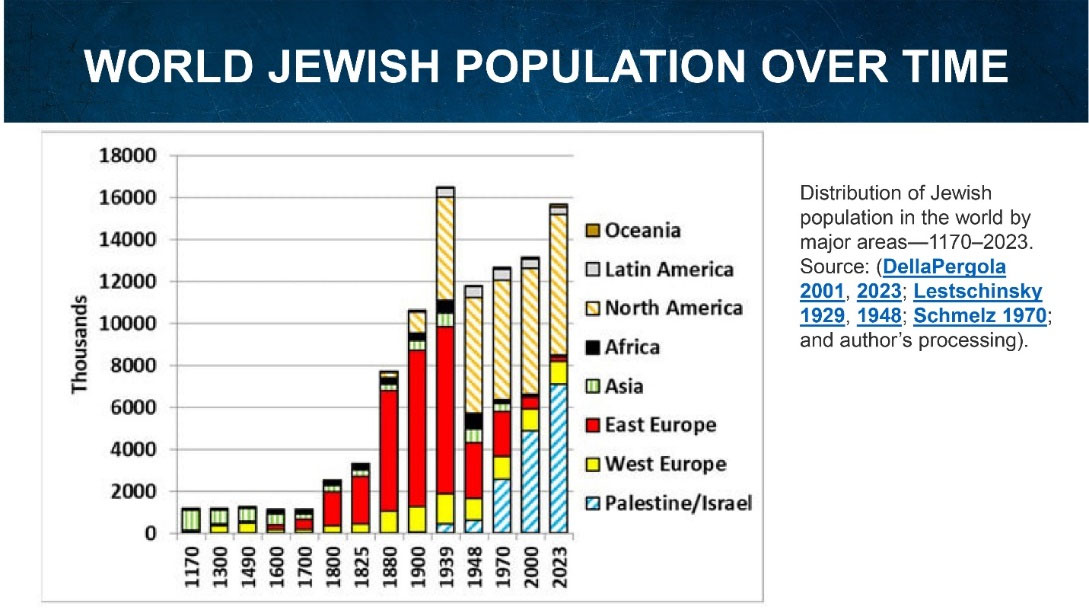
Data: Sergio DellaPergola (2001, 2023); Jacob Lestschinsky (1929, 1948); U.O. Schmelz (1970); compiled by Jonathan D. Sarna.
Eastern European Jewry has essentially disappeared — the Shoah, the postwar exodus from the Soviet Union, and now the Russian-Ukraine war saw to that. Jewish communities across Asia, the Arab world, and Iran have likewise mostly relocated, chiefly to Israel and the U.S. What remains is a Jewish people concentrated in two centers of roughly equal size:
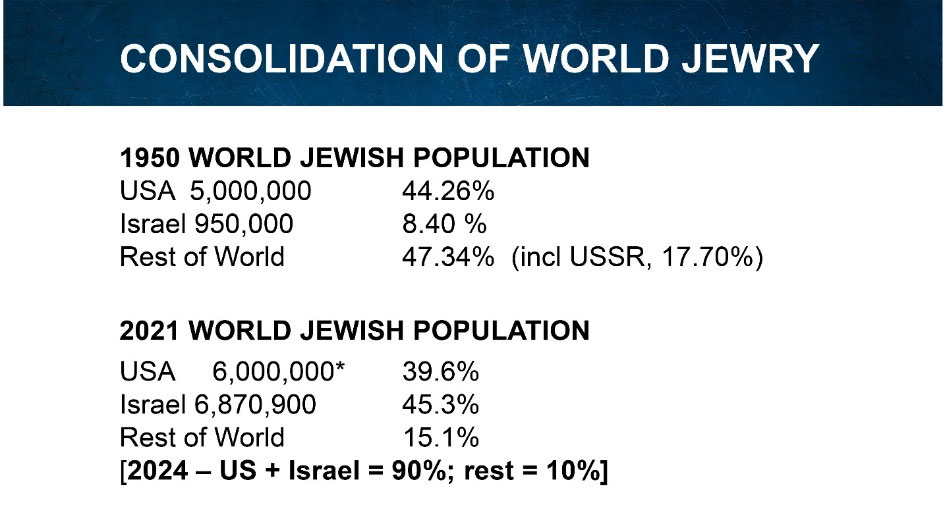
By 2024, roughly 90% of world Jewry lived in just two countries: the United States and Israel. Sarna frames this as a modern echo of Bavel Veyerushalayim — Babylon and Jerusalem in antiquity — two interdependent centers rather than a people scattered across the globe. It also means world Jewry has become, in his words, a people and a faith of the developed world, which shapes how the rest of the world encounters (or fails to encounter) Jews and Judaism firsthand.
2. Bifurcation: one community, dividing in two directions
Even as American Jews consolidate geographically, they are diverging from one another — religiously, educationally, and through marriage.
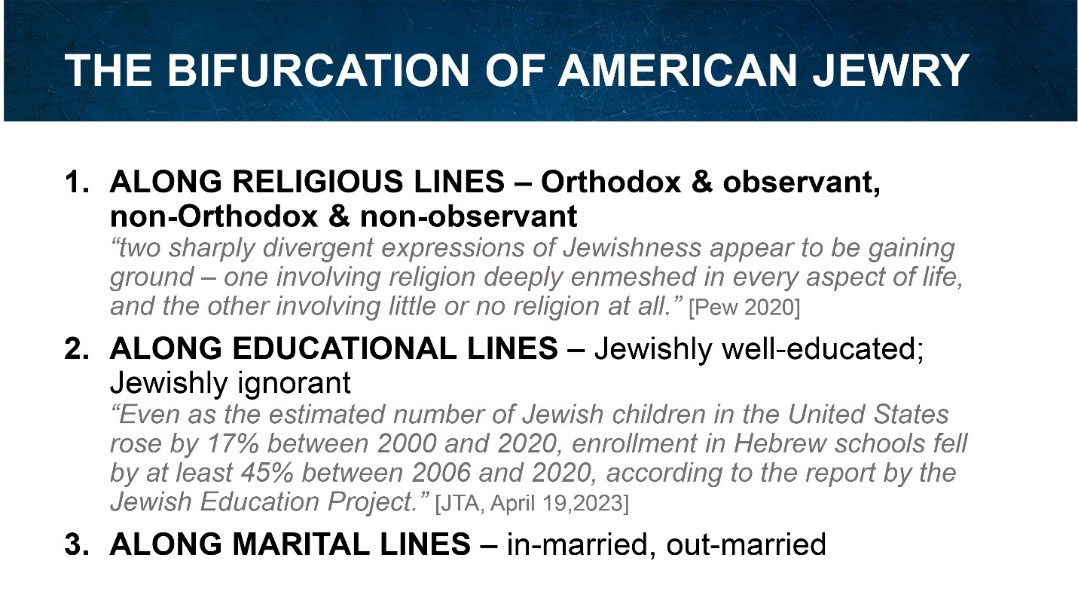
Sources: Pew Research Center; the Jewish Education Project (via JTA, April 2023).
- Religiously, Pew's research finds two sharply diverging expressions of Jewish identity gaining ground — one deeply religiously engaged, the other largely secular — with the once-large religious middle eroding.
- Educationally, the same split holds: even as the number of Jewish children in the U.S. rose 17% between 2000 and 2020, Hebrew school enrollment fell by at least 45% over roughly the same period. Young American Jews increasingly fall into one of two camps — Jewishly well-educated or largely unschooled — with little remaining in between.
- Maritally, intermarriage has risen sharply among recent generations:
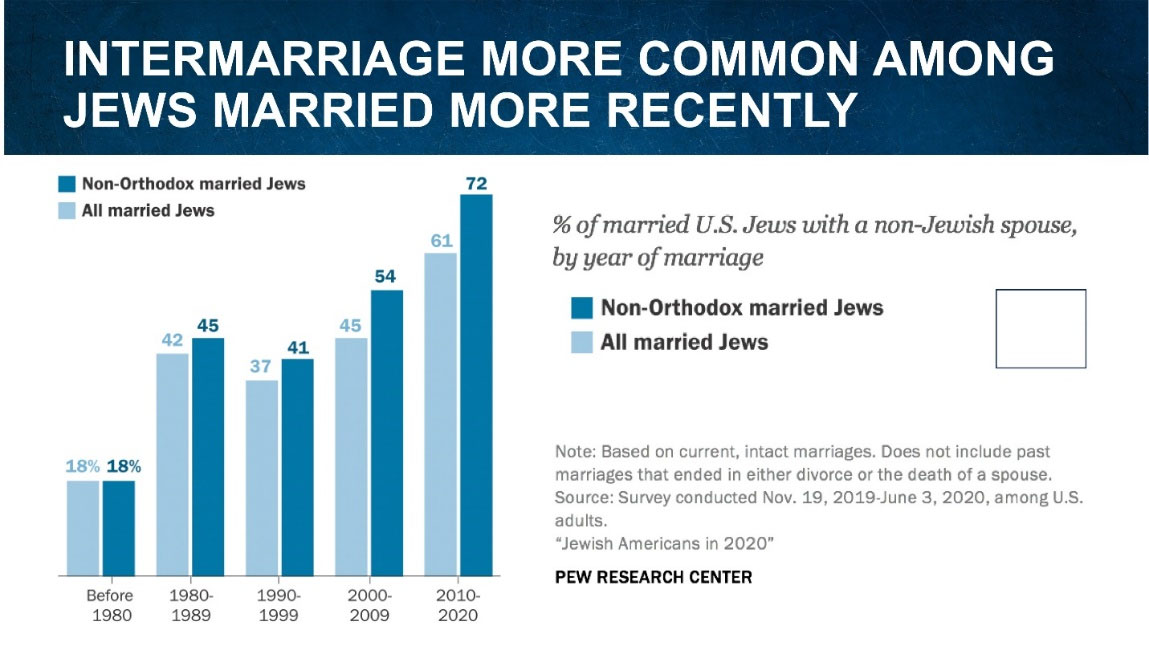
Source: Pew Research Center, “Jewish Americans in 2020.”
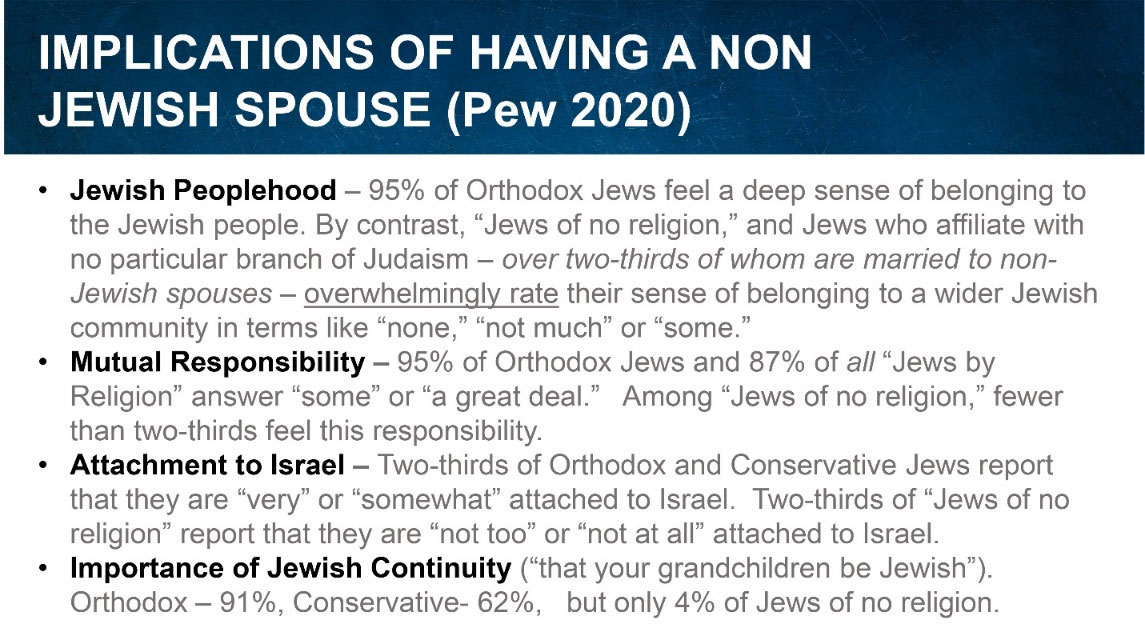
Over 70% of non-Orthodox Jews married since 2010 have a non-Jewish spouse. And that split carries real consequences for communal life:
Source: Pew Research Center, “Jewish Americans in 2020.”
Jews who identify with no particular denomination or “no religion” — a group heavily overlapping with intermarried households — report markedly lower senses of Jewish peoplehood, mutual responsibility, attachment to Israel, and priority placed on raising Jewish grandchildren than their Orthodox and Conservative counterparts.
Content and data adapted, with permission, from Dr. Jonathan D. Sarna's January 2025 Shalom Austin lecture. Underlying research cited by Dr. Sarna includes Sergio DellaPergola, Jacob Lestschinsky, and U.O. Schmelz (world Jewish population estimates); the Pew Research Center's “Jewish Americans in 2020” study; and the Jewish Education Project. Full lecture materials courtesy of Shalom Austin.